Smothered Chicken
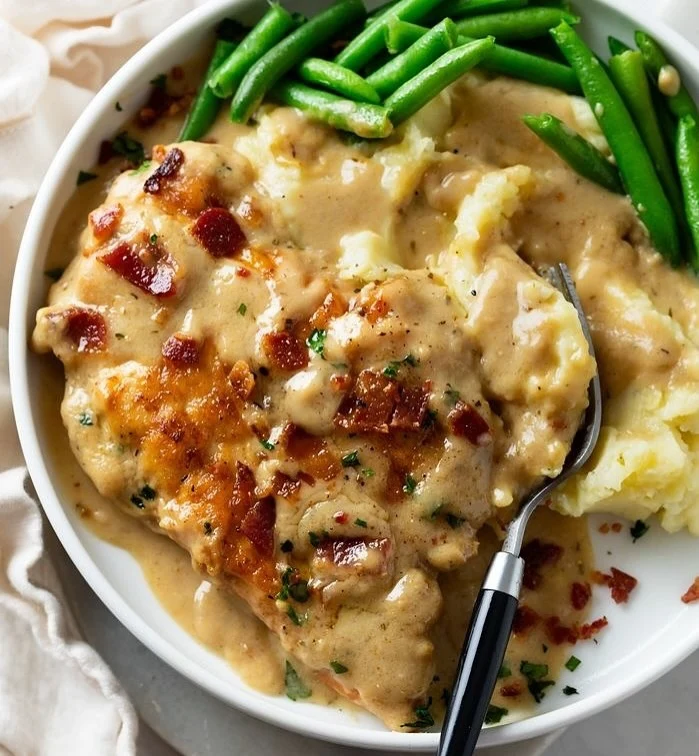
Smothered Chicken With Mushroom Gravy and Crispy Bacon
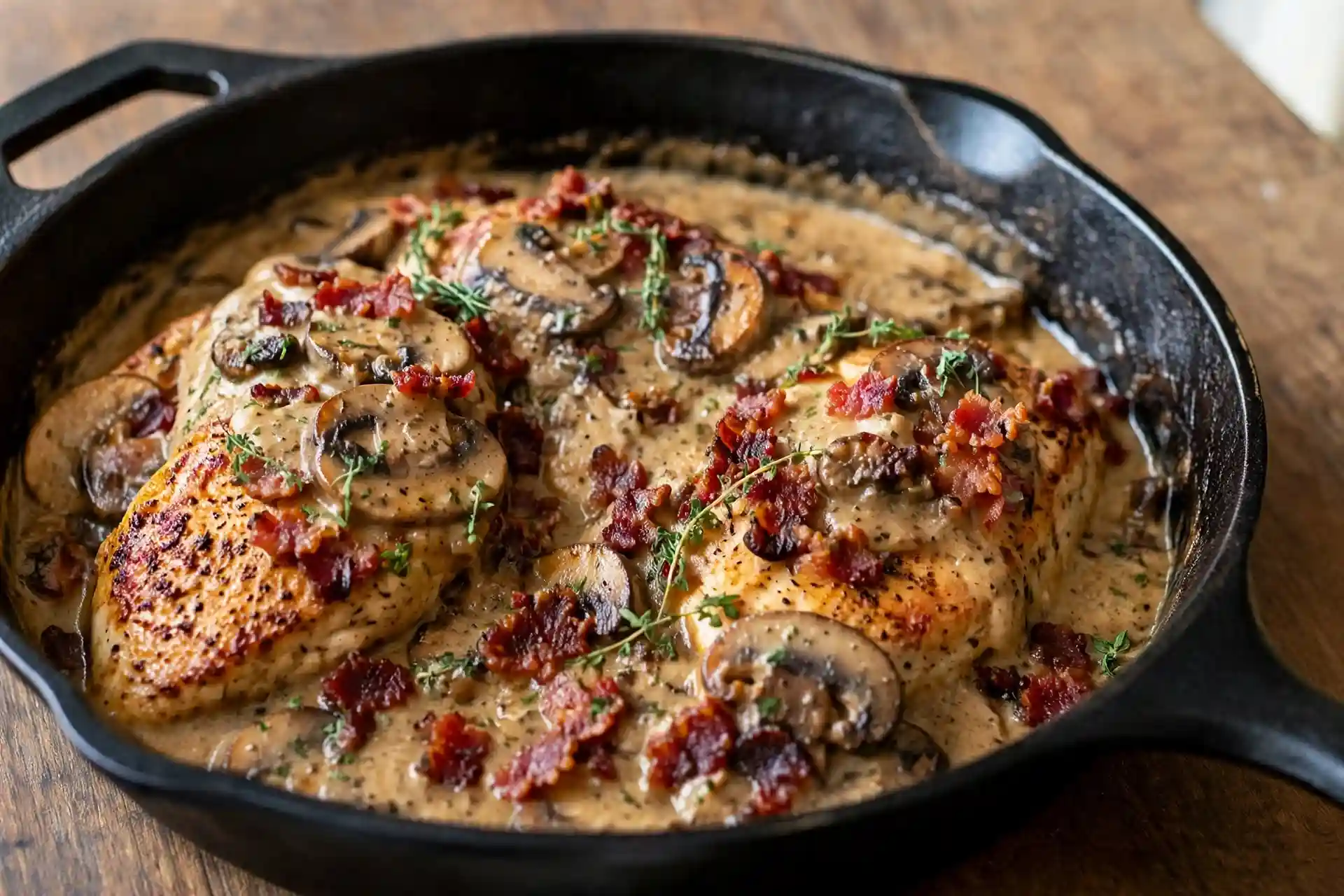
Smothered chicken is pan seared chicken breasts cooked low and slow in a thick, savory gravy until the meat turns fork tender and the gravy soaks into every bite. The dish leans on a Southern technique: brown the chicken hard first, then build the gravy right in the same pan using everything left behind.
Most versions go wrong by skipping the sear or rushing the gravy. Chicken dropped straight into liquid never develops the browned crust that gives the final gravy its depth, and a gravy that’s whisked together too fast comes out thin and pale instead of thick and glossy. This recipe fixes both. The chicken gets a hard sear in bacon fat, and the gravy builds slowly from a flour based roux cooked in that same fat before any liquid goes in.
The recipe serves four, takes about 45 minutes, and turns a few pantry staples into something that tastes like it simmered far longer than it actually did.
Why This Smothered Chicken Recipe Tastes So Deep
- Bacon fat left in the pan after crisping becomes the base for both the sear and the gravy, so the smoky flavor runs through the whole dish instead of sitting only in the garnish.
- A hard sear on the chicken before it ever touches liquid builds a browned crust that dissolves back into the gravy, the same fond that makes a good pan sauce taste rounder than a quick one.
- The roux cooks for a full 2 minutes before any broth goes in, which is long enough to lose its raw, starchy taste without browning past a light golden color.
- Mushrooms get their own sauté time in the same fat, so they brown properly instead of steaming gray and rubbery in a crowded pan.
- The chicken finishes simmering directly in the gravy rather than being added back at the very end, so the meat absorbs flavor instead of just sitting under a sauce.
- Everything happens in one skillet, so there’s a single pan to clean once dinner is on the table.
Quick Recipe Snapshot
- Prep time: 15 minutes
- Cook time: 30 minutes
- Rest time: 5 minutes
- Total time: 50 minutes
- Servings: 4
- Difficulty: Easy
- Calories: About 460 per serving
- Most important tool: A 12 inch heavy bottomed skillet
- Best for: Weeknight dinners, Sunday comfort food, make ahead meals
Ingredients
The Chicken and Bacon
Pounding the chicken to an even thickness matters more here than in most recipes, since uneven pieces finish simmering at different times and the thin end can turn dry while the thick end stays underdone.
- 4 boneless skinless chicken breasts (about 6 ounces each)
- ¾ teaspoon fine salt, divided
- ½ teaspoon black pepper, divided
- ½ teaspoon garlic powder
- ½ teaspoon smoked paprika
- 2 tablespoons all purpose flour, for dredging
- 4 slices thick cut bacon, diced
The Gravy
Deglazing with broth while the pan is still hot lifts every browned bit left behind, and those bits carry more flavor than any bouillon cube could add on its own.
- 1 medium yellow onion, thinly sliced
- 8 ounces cremini mushrooms, sliced
- 3 garlic cloves, minced
- 3 tablespoons all purpose flour
- 2½ cups chicken broth
- 1 teaspoon Worcestershire sauce
- 1 teaspoon fresh thyme leaves, or ½ teaspoon dried
- ¼ cup heavy cream, optional
To Finish
- 2 tablespoons chopped fresh parsley
Substitutions that hold up: Boneless skinless chicken thighs work in place of breasts at the same weight, and they stay slightly more forgiving if the simmer runs a few minutes long. Turkey bacon replaces the pork bacon with less rendered fat, so add 1 tablespoon of oil to the pan to make up the difference. Half and half can replace the heavy cream for a lighter gravy, though it won’t thicken quite as richly.
Recipe Timing
- Prep: 15 minutes
- Cook: 30 minutes
- Rest: 5 minutes
- Total: 50 minutes
- Servings: 4
- Difficulty: Easy
- Cuisine: Southern American
- Course: Dinner
Looking for another rich, sauce forward chicken dinner? Butter chicken builds a similarly deep gravy with a completely different spice profile.
Allergen and Dietary Disclosure
This dish contains dairy (optional cream) and wheat/gluten (flour, both dredge and roux). Worcestershire sauce sometimes contains fish or soy, so check the label if either is a concern.
- Dairy: Skip the heavy cream entirely. The gravy will be slightly thinner and less rich, but still full flavored from the roux and bacon fat alone.
- Gluten: Swap both flour measurements for the same amount of cornstarch, mixed into a slurry with a splash of cold broth before stirring it into the hot fat, and confirm your Worcestershire sauce is labeled gluten free.
Equipment Needed
- 12 inch heavy bottomed skillet. Cast iron or a heavy stainless pan holds heat evenly through both the sear and the long simmer.
- Meat mallet or rolling pin. Pounds the chicken to an even thickness so it cooks at a consistent rate.
- Tongs. Makes turning the chicken and lifting the finished bacon far easier than a fork.
- Whisk. Smooths the roux into the broth without lumps forming as the gravy comes together.
Nutrition Information
Per serving (1 chicken breast with gravy, 4 servings per recipe):
- Calories: 460
- Protein: 42 g
- Carbohydrates: 14 g
- Fat: 26 g
- Fiber: 1 g
- Sugar: 3 g
- Sodium: 980 mg
The bacon and optional cream account for most of the fat in this dish, so leaving out the cream and blotting the bacon well trims the fat column by roughly 8 grams a serving. These figures are estimates built from USDA FoodData Central data and shift with the exact cut of chicken and how much fat is left in the pan.
How Smothering Builds a Gravy With Real Depth
The browned bits left in a pan after searing meat, often called fond, carry concentrated flavor that no amount of broth or bouillon replicates on its own. Searing the chicken hard before the gravy begins means that fond is already sitting in the pan, waiting to dissolve the moment liquid hits it, the same principle behind deglazing a pan for a quick steak sauce.
A roux works as a thickener because flour cooked in fat coats each starch granule in oil, which keeps the granules separated and prevents the clumping that happens when raw flour meets hot liquid directly. Cooking the roux for a full 2 minutes before adding broth also cooks off the raw flour taste that can leave a gravy tasting chalky, the same reason a bechamel sauce calls for cooking the butter and flour together before the milk goes in.
Simmering the chicken directly in the finished gravy, rather than cooking it separately and combining the two at the end, lets the meat actively absorb the gravy’s flavor as it finishes cooking, the same reason a braise tastes more integrated than meat simply topped with a sauce after the fact.
What is smothered chicken? Smothered chicken is a Southern dish of pan seared chicken simmered in a thick, savory gravy, traditionally built from the drippings left behind after browning, until the meat is tender and fully coated.
Preparation
Pat the chicken breasts dry with a paper towel, then place them between two sheets of plastic wrap and pound gently with a mallet until evenly thick, about ¾ inch throughout. Season both sides with half the salt, half the pepper, the garlic powder, and the smoked paprika, then dust lightly with the 2 tablespoons of flour. Slice the onion and mushrooms, mince the garlic, and measure the broth so it’s ready to pour in quickly once the roux is cooked.
Step by Step Method
Cook the diced bacon in the dry skillet over medium heat, stirring occasionally, until crisp and deeply browned, about 6 minutes. Lift it out with a slotted spoon onto a paper towel, leaving the rendered fat behind in the pan.
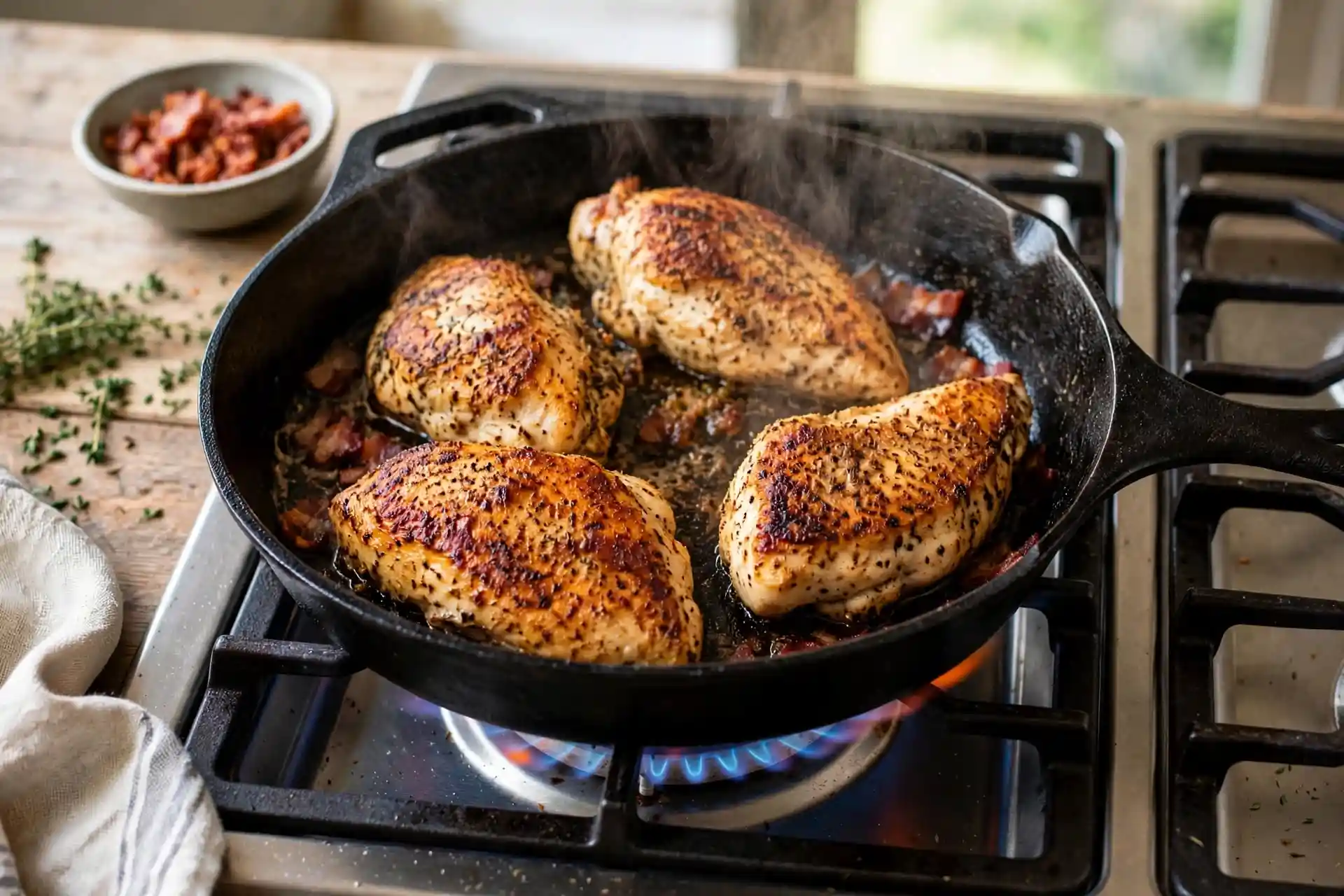
Raise the heat to medium high. Lay the dredged chicken breasts into the hot bacon fat and sear undisturbed for 4 minutes per side, until a deep golden crust forms and the chicken releases easily from the pan.
Chef’s Note: If the chicken sticks when you try to turn it, it isn’t ready. A properly seared piece releases on its own once the crust has fully formed.
Transfer the chicken to a plate. It won’t be fully cooked through yet, and that’s expected, since it finishes in the gravy.
Add the onion and mushrooms to the same pan. Stir occasionally for 6 minutes, until the mushrooms release their liquid and that liquid evaporates, leaving browned edges behind.
Clear a space in the center of the pan, add the garlic, and stir for 30 seconds until fragrant. Sprinkle the flour over everything and stir constantly for a full 2 minutes, until the mixture turns a light golden color and smells toasted rather than raw.
Chef’s Note: Rushing the roux is the step most cooks skip, and a gravy built on undercooked flour tastes chalky no matter how much broth you add afterward.
Pour in the broth gradually, whisking constantly to work out any lumps as the liquid is added. Stir in the Worcestershire sauce and thyme, then bring the gravy to a steady simmer.
Nestle the seared chicken breasts back into the gravy along with any juices that collected on the plate. Spoon gravy over the top of each piece.
Chef’s Note: Spooning gravy over the chicken as it simmers keeps the exposed top from drying out, since it isn’t fully submerged in the liquid.
Cover and simmer on low for 15 to 18 minutes, until the chicken reaches 165°F at the thickest point and the gravy has thickened enough to coat the back of a spoon.
Stir in the heavy cream if using, along with half the crispy bacon, and simmer uncovered for 2 more minutes to loosen the gravy slightly and warm the cream through.
Remove from the heat and let the dish rest for 5 minutes. Top with the remaining bacon and the chopped parsley before serving.
Callout: Taste the gravy before adding any extra salt. Bacon, Worcestershire sauce, and the broth all carry sodium, and this dish rarely needs more than the amount already built into the recipe.
Expert Tips and Tricks
- Make ahead: Sear the chicken and build the gravy through step 6 up to a day ahead, then refrigerate separately. Reheat the gravy gently, add the chicken, and finish at step 7.
- Storage: Cool leftovers to room temperature within 2 hours, then move them to an airtight container for the fridge.
- Pound the chicken evenly: Uneven thickness means uneven cooking, and the thin end of a tapered breast dries out long before the thick end finishes.
- Don’t rush the roux: A full 2 minutes of cooking removes the raw flour taste that a quick stir leaves behind.
- Brown the mushrooms properly: A crowded pan steams mushrooms instead of browning them. Give them room and let the liquid they release cook off before moving on.
- Reserve some bacon: Splitting the bacon between the gravy and the final garnish keeps some of it crispy instead of all of it softening in the sauce.
- Check the temperature, not just the clock: Chicken breast thickness varies enough that 165°F on a thermometer is a more reliable cue than the minute count alone.
For a faster weeknight chicken dinner with a sweeter glaze instead of a gravy, honey garlic chicken is worth keeping in the same rotation.
Common Mistakes and Troubleshooting
The gravy tastes thin and watery. The roux likely didn’t cook long enough, or too much broth went in at once. Simmer the gravy a few extra minutes uncovered, and next time whisk the broth in more gradually.
The chicken turned dry. It probably simmered past 165°F internal, or the pieces weren’t pounded to an even thickness. Check with a thermometer and pull the chicken the moment it hits temperature.
The gravy tastes chalky or raw. The roux didn’t cook long enough before the broth went in. Give it the full 2 minutes next time, watching for a light golden color and a toasted smell.
The mushrooms turned gray and rubbery instead of browned. The pan was too crowded, which caused them to steam instead of sear. Use a wide enough pan and resist stirring constantly during that step.
The bacon turned soft in the gravy. All of it simmered in the sauce instead of being reserved. Keep half the bacon aside and add it only in the last minute, or scatter it fresh on top right before serving.
Honest Trade-Off
This dish leans on bacon fat and a flour roux rather than the long, slow braise some traditional smothered chicken recipes use, which means the gravy comes together faster but doesn’t develop quite the same deep, hours long complexity. Anyone chasing that slow cooked depth should look for a version that braises longer on the stovetop or in the oven. This recipe suits a weeknight where 45 minutes, not an afternoon, is the realistic budget.
Storage and Make Ahead
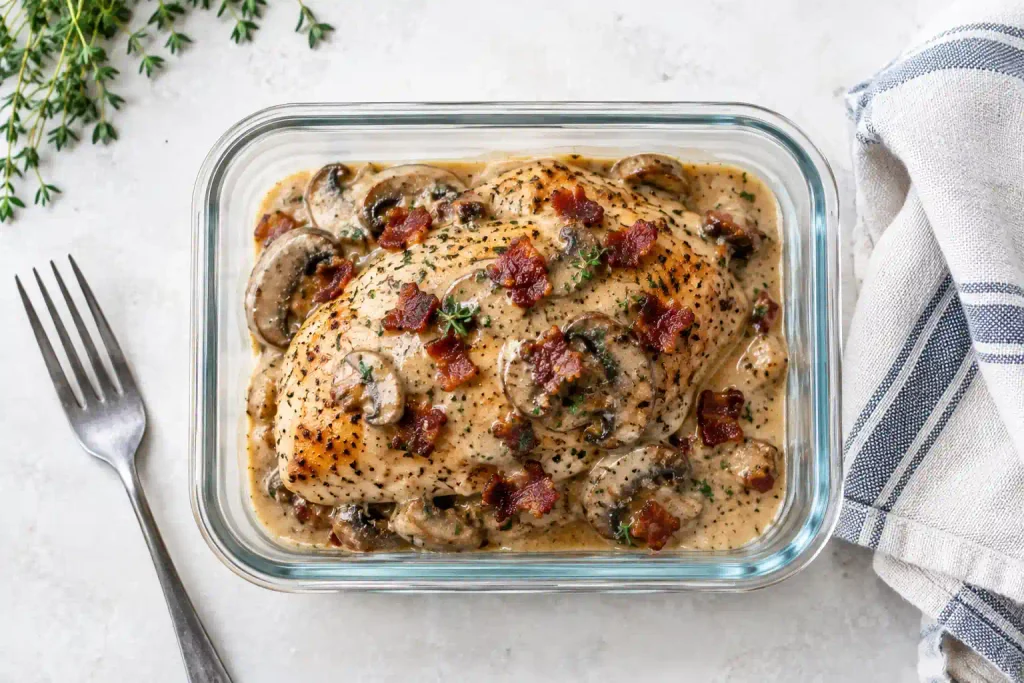
Refrigerator: Store in an airtight container for up to 4 days. The gravy thickens further as it chills.
Reheating: Warm gently in a skillet over medium low heat, adding a splash of broth to loosen the gravy back to its original consistency. Microwaving works for single portions but can toughen the chicken slightly if overheated.
Freezer: Freezes well for up to 3 months, though cream based gravy can separate slightly on thawing. Thaw overnight in the fridge and reheat gently, whisking the gravy to bring it back together.
Variations and Substitutions
- Spicy: Add ¼ teaspoon cayenne to the chicken seasoning, or stir a dash of hot sauce into the finished gravy.
- Cheesy: Stir ½ cup of shredded sharp cheddar into the gravy during the last 2 minutes of simmering.
- No pork: Use turkey bacon and 1 tablespoon of oil in place of the pork bacon and its rendered fat.
- Extra vegetables: Add a cup of sliced bell peppers along with the onion for more color and a slightly sweeter gravy.
- Low carb: Skip the flour dredge on the chicken and use only the cornstarch slurry method for the gravy to lighten the carb count.
Serving Suggestions
Smothered chicken sits naturally over mashed potatoes or steamed rice, since both soak up the gravy well. Buttermilk biscuits on the side work for mopping up whatever the rice or potatoes don’t catch. A simple green vegetable, like steamed green beans or sautéed spinach, balances the richness of the dish. For a lighter night later in the week that still satisfies a craving for saucy chicken, chicken stir fry offers a completely different, quicker direction.
Callout: Warm the serving plates in a low oven for a few minutes before plating. Gravy cools and thickens fast on a cold plate, and a warm one keeps it pourable through the whole meal.
Frequently Asked Questions
Can I make smothered chicken ahead of time?
Yes. Sear the chicken and build the gravy up through the point just before adding the chicken back in, then refrigerate both separately for up to a day. Reheat the gravy, add the chicken, and finish the simmering step fresh so the meat doesn’t overcook from a second full reheat.
Why is my gravy thin instead of thick?
The roux usually didn’t cook long enough before the broth went in, or the broth was added too quickly for the flour to absorb it smoothly. Simmer the finished gravy a few extra minutes uncovered to reduce and thicken it, and whisk the broth in more gradually next time.
Can I use chicken thighs instead of breasts?
Yes, and thighs are more forgiving if the simmer runs a few minutes long, since they carry more fat and stay moist longer than lean breast meat. Use the same weight and follow the recipe exactly as written, checking for the same 165°F internal temperature.
How do I know when the chicken is fully cooked?
Check the thickest part of the breast with an instant read thermometer. It should read 165°F, which is the temperature the USDA lists as safe for poultry. The gravy should also have thickened enough to coat the back of a spoon by the time the chicken reaches that temperature.
Is smothered chicken safe for someone with a dairy or gluten allergy?
The standard recipe contains gluten in both flour measurements and optional dairy in the heavy cream. Cornstarch replaces the flour in a slurry, and the cream can be left out entirely without losing the core flavor of the dish. Check your Worcestershire sauce label too, since some brands include fish or soy.
Conclusion
The sear is what separates this dish from a chicken breast simply simmered in gravy. Give the chicken its full 4 minutes per side before it ever touches liquid, and the fond left behind does more work for the final flavor than any extra seasoning could add later. Keep the leftover gravy in mind too, since it reheats well enough to turn a second night’s plain rice into something worth looking forward to.
Smothered Chicken
Ingredients
Method
- Crisp the bacon, then remove it and leave the fat in the pan.
- Sear the dredged chicken 4 minutes per side in the bacon fat, then remove.
- Sauté the onion and mushrooms 6 minutes until browned.
- Add garlic for 30 seconds, then sprinkle in the flour and cook 2 minutes.
- Whisk in the broth gradually, then add Worcestershire sauce and thyme.
- Return the chicken to the gravy and spoon gravy over the top.
- Cover and simmer 15 to 18 minutes until the chicken reaches 165°F.
- Stir in the cream and half the bacon, simmer uncovered 2 minutes.
- Rest 5 minutes.
- Top with remaining bacon and parsley before serving.